All
in the bucket !
Text in deutsch
The article describes a
classical
experiment of a rotating bucket, which
already was carried out
by Isaac Newton. He saw this experiment as an argument to
the existence of an absolute motion towards an "absolute
space". The following interpretation shows, that
this phenomenon is not a reference to an "absolute space".
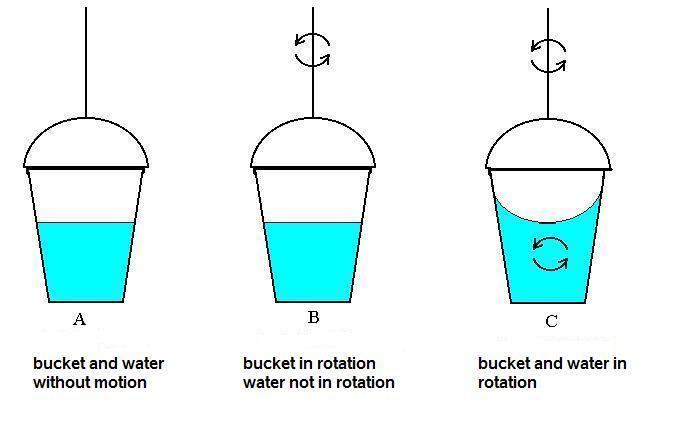
Isaac Newton imagined, that at the beginning of the experiment a bucket
with water is hanging on a rope without motion. The surface
of water is plane ( A ) . In the next step
the bucket begins to rotate. In the first seconds only the bucket
is in rotation ( B )
and the water remains plane. Afterwards, also the water
content
begins to rotate and at the end of the experiment, bucket
and water are in the same rotation ( C ). In the
final state exists no motion between bucket and water ( like
at
the beginning ). The difference between starting and final state is,
that in state ( A ) the surface of water
is plane and in state ( C ) the surface
is curved concave.
Newton took the
conclusion, that the difference between starting and final state is
caused by an absolute motion of water in
comparison to an "absolute space". However,
the existence of an "absolute space" was also in Newtons living
times disputed by other scientists .
In the 19. century the physicist and philosopher Ernst Mach
also dealt with this experiment. He was convinced, that an "absolute
space" is not existing. He supposed in a desperate act, that, if the
rest of mass points in the universe would rotate around the water
bucket, this would result the same concave curved surface of water.
The following part of this article shows, that there is no
contradiction between this experiment and the non-existence
of an "absolute space".
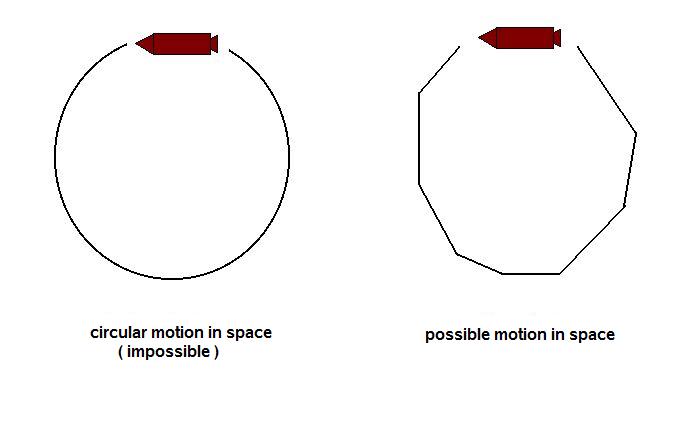
In the first step we have to imagine, that we fly in a
spaceship in an empty area of the universe. From the
headquarter comes the order, that we have to move in a circle until
the next destination is made. In this case you would shake
with your head and complain about such an order. In an empty space
it is impossible to move in a circle, because you can only change your
direction by several (energy consuming) direction alterations. The
resulting lane is only an addition of several lines and not a real
circle.
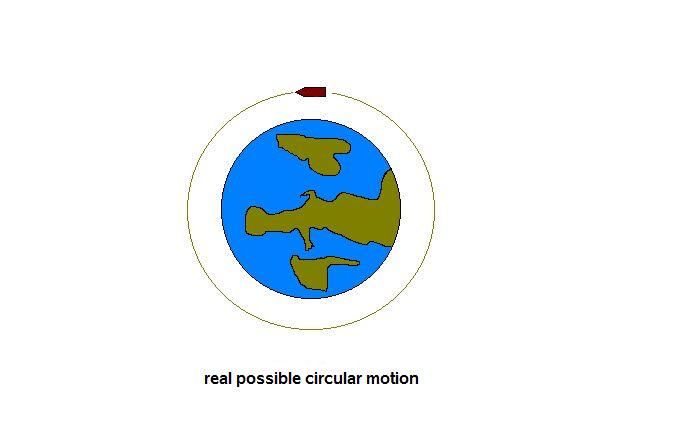
If we want to follow such resolute order, we have to look for a planet
and fly around this planet in a stable orbit, which is a real
circle without consumption of energy. In this state, gravitation and
centrifugal force are in balance. Now we can take the conclusion, that
for a real circle moving we need two
mass points ( or better at least two ) in an empty space.
A circle moving is in the deepest nature not an
one point phenomenon .
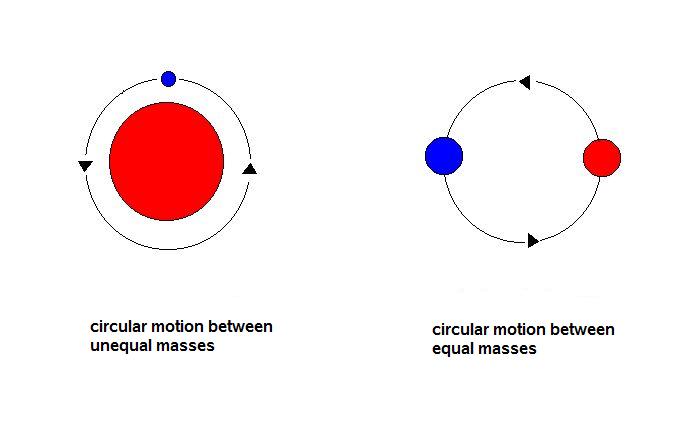
In the next step we have to imagine, that such rotation also
is possible
with two equal masses in space. In this case, both masses are circling
around each other. Gravitation and centrifugal forces are in
balance.
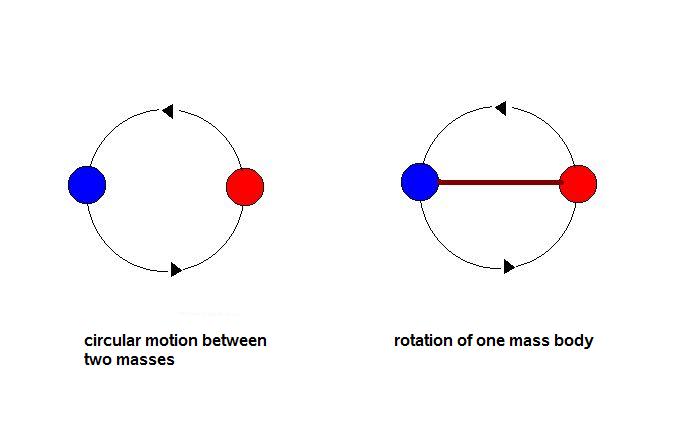
At last, it is possible to
fix a bar between the two masses. In this step we change from two
masses into one mass body. Now we have a rotating body in space. If
this rotation is harmonious ( gravitation and centrifugal
force in balance ) , there is no force to the connecting bar. However ,
when the speed of rotation is increasing, a draft force occur to
the bar. In this case, electric binding power between atoms
(or molecules) of the bar prevent
an increasing ( harmonious ) distance between the
mass points. This space/time non-harmonious of the
gravitation circling motion is balanced by a space/time non-harmonious
of the binding electrons in atomic orbitals. The binding electrons now
are moving in "shifted" orbitals and so the length of the
bar is a little bit bigger.
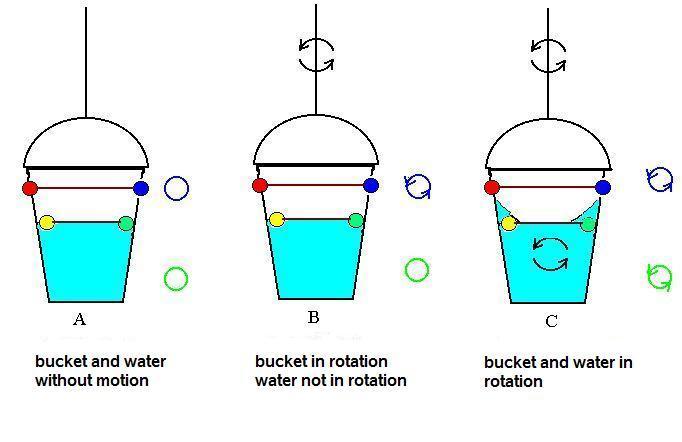
Finally we go back to the bucket. When we consider our new point of
view about rotation,
we can divide the water bucket in two rotation systems. One
is the bucket itself and the other the water content. The red and
the blue balls as well as the yellow and green are two
point systems, representative of all points from the
water bucket. When the bucket begins to rotate, the atoms of
the bucket wall have to balance the new centrifugal force with their
binding electrons and so the wall will be stretched a little, little
bit.
In the other system, the water content is in rotation. But here,
binding forces between the single water molecules are not strong enough
to balance the centrifugal force. In this case, the balance
results by an increasing water level into the direction of
the bucket wall and in this way a higher weight pressure as
compensation.
Summary: The mistake of
Newton and Mach
was, that both the water rotation saw as an one
point space/time phenomenon. Newton, in contrary to Mach, was in this
point of view very content, because he wanted to show a rotation
relative to an absolute space. On the other hand, Mach
was desperate looking for a solution of this problem without
banishing
the concept of a non-absolute space.
But in the same way, like it is impossible for a single spaceship to
move in a circle, a rotation is ever a two (at
least) point space/time phenomenon. All water molecules are
single systems, which circling around each other.
link to perpetual
motion machine in reality
E-Mail: newtonexperiment@email.de